
Yeoh Siew Hoon
While everyone was traipsing round the world during the holiday season, I stayed home in Singapore and watched the world go by, in posts, reels, streams and stories.
When did the world become a stage where everyone is an actor in their own movie?
From their posts, it seemed half of my friends were in Japan and the other half in China. China's visa-free policies have really worked for markets in Southeast Asia. Airlines have launched numerous flights to secondary cities, and travelers are fanning out to previously harder-to-access destinations such as Xian Nanjing, Ningbo. Chengdu is a consistent favorite.
I asked my 30-something-year-old niece, who spent two weeks traveling around northern China, what she liked about the country. "It's interesting, each area is so different. It's affordable, the food is good and the tech is so convenient." Superapps have removed many of China's travel barriers, including language, for the mobile-wielding populace of Asia.
So my first prediction for 2026 -- not that hard, really: China inbound will be the breakout news in Asia.
Anyway, in between these bouts of voyeurism watching other people's holiday reels, I visited local places, slowed down, read books and watched movies made by professionals.
In the interest of being on-trend, and I apologize for taking more than 15 seconds of your time -- the gold standard for video content these days -- I will attempt to summarize my thoughts gathered over the holidays in four points.
1. Be the standout, not the stand-in.
One day, I decided to explore "rural" Singapore. I shared this desire with my friend in New Zealand, who promptly laughed. "Is there any rural left in Singapore?"
Well, turns out there is one last kampong (village) left. It's called Kampong Buangkok. It's really easy to miss, sandwiched between highways and high-rise buildings. A gravel path. Wooden houses. Fruit trees spilling over fences. A rooster crowing in the distance.
It somehow feels out of place, yet in sync, like it has always had a right to be there. It was founded in 1956 by Sng Teow Koon, who leased land to families at low rents.
What's remarkable is that it's survived the massive development Singapore has undergone. That's because the founder's daughter, Sng Mui Hong, often referred to as Singapore's "last kampong landlord," resisted every offer from developers eager to monetize the 12,248 square meters left of the land. Today, about 30 families live here and continue paying low rents.
It's a quiet statement of personal choice, resistance against the norm, standing out and standing up for what matters to you.
In a world where everything is being sucked up by machines and crushed into a pulp of sameness, folks like her may be the heroes of our time.
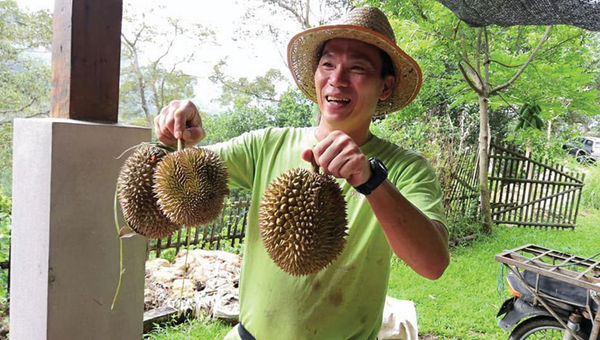
Eric Chong of Green Acres runs durian workshops on his farm in Penang. Photo Credit: Green Acres
2. Take it slow and smell the durians.
As I slowed down, my mind went back to our last Web in Travel event of the year, in Seoul, when we invited a farmer from Penang, Eric Chong of Green Acres, to talk about the slow tourism trend he thinks will pick up pace this year and which he's seen grow since the pandemic.
He's a proponent of the slow food travel movement, whose aim is "to bring travelers closer to the preservation of food biodiversity and an understanding of local cultures, identities and gastronomies."
He and his wife, Kim, both corporate trainers, actually bought the 16-acre farm as a retirement idea almost 10 years ago, based on a desire to reconnect their son with nature. They resolved to turn it into an organic farm, the only one in an area known for rich durian harvests.
They found out it's hard to make a living from fruit farming, even with durians, that most highly prized fruit that stinks like hell and tastes like heaven. So putting their corporate skills to good use, the duo got into tourism, creating experiences for individuals, corporate and school groups.
His guests come from everywhere. Indeed, one guest from Oregon, Lindsay Gasik, visited Green Acres several years ago. She now runs a durian-focused travel business, running tours and shipping the fruit to customers in the U.S., Canada and the EU.
Beyond hunting for durians, Chong said, many visitors seek nature and a slower form of travel.
"They come to our farm to learn about organic farming, the origins of food as well as activities such as harvesting, and we take them on tours to nearby villages to see a rural side of life," he said.
What they enjoy is the personal touch of the experience, with both Eric and Kim acting as hosts. "Tech cannot replace that love or that warmth," Chong said. "That's what travelers want."
When he was in Seoul, he visited a farm community in Jeongup, two hours outside the city, to experience slow travel himself.
He found the people to be friendly everywhere he went, offering him free food and drinks. He found the local tea, ssanghwacha, made by a collective of local farmers, so good that he wondered why hotels in Seoul didn't offer local teas. "Travelers are looking for local -- whether it's getting out there to feel something local or eating or drinking," he said.
Sounds like the perfect antidote to a year of demon-paced change.
3. The lost art of letter writing and keeping open minds.
I normally avoid books that tell their stories via letters. For some reason, probably some early childhood trauma, I find it hard to read other people's letters.
But conscious that I need to break out of my own algorithmic bubble from time to time, I decided to pick up "The Correspondent" by Virginia Evans, in which a woman's life is told through her letters to others.
It made me want to write letters again.
Correspondence from the book makes a case for it: "Imagine all that you have said to another, all the commentary you have exchanged with friends over drinks, over the phone with colleagues and distant relatives, all the prattle sent quickly, mindlessly over email, messages typed into your cellular phone, and really the sum of this interpersonal communication is the substance of your life, relationships being, as we know by now in our old ages, the meat of our lives; but all of that is gone. Vanished!"
The unexpected joy I found in something I'd normally eschew made me realize that keeping an open mind has become one of the biggest challenges of our time.
Algorithms keep us in our bubbles, information is so readily available we know everything about anything. Social feeds with impossibly beautiful images raise our expectations -- how do you keep your mind open when it's constantly manipulated and filled with so much clutter?
Yet, the best way to travel is with an open mind. Even better, travel with a pen and writing pad to write letters, even if only to yourself.
4. Be prepared for 'One Battle After Another.'
I simply cannot bring myself to write anymore about "KPop Demon Hunters," but one movie I feel touches a global nerve is Paul Thomas Anderson's "One Battle After Another."
It's been described as a breathless action thriller, but it's more than that. It's epic. It's brave. It's naughty. It's funny. It's ironic. It's rebellious. A fellow movie buff described it as "the type of anti-hero hero for this current moment, that we didn't know we needed."
For Western audiences, it's this generation's "Easy Rider." For Eastern audiences, it's this generation's "Enter the Dragon."
It's also a love story and, as we well know, love is universal.
Watching it -- especially that crazy, head-spinning, heart-stopping car chase on the rolling hills -- made me think that travel in 2026 will be very similar, whether you're in Osaka, Oman or Oregon.
It will be one battle after another as we await where technology, politics and economics take us and we figure out how best to maneuver our way up and down those hills.
Spoiler alert: In the movie, the newer, faster car does not win.
Happy 2026.