
Christina Jelski
Opulent resorts, entitled vacationers and a murder-mystery plot line are all hallmarks of the hit HBO series "The White Lotus," but this year the dramedy adds another layer of excess: luxury wellness.
The show's third season, which debuted last month, transports viewers to a White Lotus-flagged wellness resort in Thailand, where pampered guests are matched with personal "health mentors."
(The fictional property was created by filming across four real resorts: The Four Seasons Koh Samui, Anantara Bophut Koh Samui, Anantara Mai Khao Phuket Villas and Rosewood Phuket.)
The White Lotus brand may not be real, but the wellness trends showcased this season are very much rooted in reality. Here's what the show gets right about today's wellness landscape.
Digital detox
In the season's debut episode, the dysfunctional Ratliff family is caught off guard when informed of the resort's no-phone policy. Guests are to refrain from using digital devices in public spaces, and guestrooms lack WiFi.
The family's health mentor even offers to collect their devices in a bag, something that parallels my experience at the Miraval Berkshires Resort and Spa in Massachusetts -- although Miraval guests have access to designated phone areas and in-room WiFi.
The Global Wellness Summit's Future of Wellness 2025 Trends report ranks "analog wellness" as the year's top trend, with research director Beth McGroarty declaring that "digital detox cabins in the wild, disconnection retreats and phone-free adventure tours feel more aspirational than spa palaces and biohacking clinics."
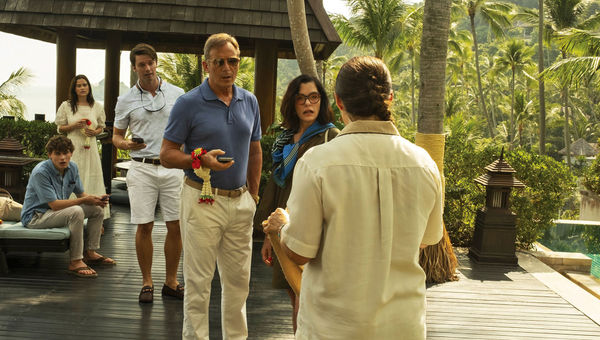
During an early episode of The White Lotus' third season, Ratliff family members (played by, from L to R, Sam Nivola, Sarah Catherine Hook, Patrick Schwarzenegger, Jason Isaacs and Parker Posey) are caught off guard when their health mentor, Pam (facing away, played by Morgana O'Reilly), informs them of their resort's digital device-free policies. Photo Credit: Fabio Lovino/HBO
Teen, family wellness
It's the Ratliff clan's three children who showcase yet another top trend from the Wellness Trends report: teen wellness.
While it's abundantly clear that no amount of sensory-deprivation tank sessions or yoga classes will untangle the bizarre dynamics among the youngest Ratliffs, their inclusion in the wellness programming mirrors real-world trends.
The Wellness Trends report highlights the Zulal Wellness Resort by Chiva-Som in Qatar, which offers family wellness consultations and personalized treatments, and Thailand's RXV Wellness Village, with its family-inclusive Everyone's Wellness programs.
Even traditionally adults-only sanctuaries like the Miraval Berkshires introduced its Family Connection Week last year, while the nearby Canyon Ranch Lenox launched its Family Week last summer.
Biomarker testing
Biomarker testing got several mentions in the season's early episodes. While not listed on this year's Wellness Trends, the report acknowledges that many wellness devotees remain eager to submit to biometric testing protocols.
Despite biomarker testing being a staple at renowned wellness concepts like the Sensei Lanai, a Four Seasons Resort in Hawaii and Canyon Ranch resorts via the brand's Longevity8 program, it's this particular treatment that the show treats with perhaps the most skepticism.
After Laurie steps on a device that's similar to a scale, her health mentor tells her that "how the [electric] current is conducted tells us a lot about what's going on in your body."
Afterward, Laurie tells her friend Jaclyn that her fat mass is under 25%, only for Jaclyn to smugly claim hers was "of someone half my age."
"He might say that to everybody," Laurie replied. "He said the same thing to me."
In that single exchange, the show captures the delicate balance between the wellness world's genuine promises of betterment and its potential for exploitation.
Unsurprisingly, at the White Lotus' Thailand resort, it's the latter that prevails.